




2026 Jeep Wrangler vs. 2026 Subaru Outback: Why the Wrangler Wins
Context matters when you’re comparing two vehicles. The 2026 Jeep Wrangler and the 2026 Subaru Outback both get marketed as adventure-ready SUVs, but that surface-level similarity fades pretty quickly once you dig into the details.
One was built to conquer trails, ford rivers, and climb rock faces. The other was built to handle the school run in the rain. In this comparison, the winner depends entirely on what kind of driver you are, and for anyone who craves real outdoor capability, the Wrangler is in a class of its own.
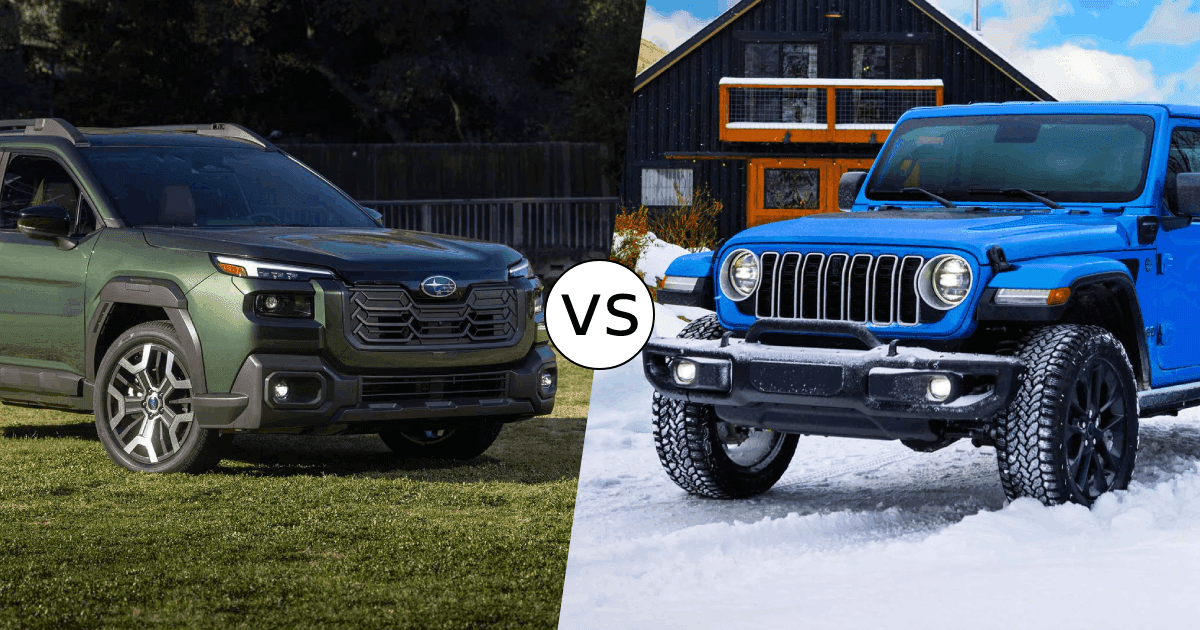
2026 Jeep Wrangler vs. 2026 Subaru Outback: Two Different Visions of Adventure
These two vehicles share almost no common ground in terms of design philosophy. The Wrangler was engineered from the ground up for rugged off-road performance. Every decision in its construction, from the solid axles to the removable body panels, reflects a genuine commitment to capability in extreme terrain. The Outback takes a fundamentally different path, prioritizing comfort, cargo space, and practical all-weather performance for everyday driving.
The Wrangler’s 2026 lineup spans seven trims: Sport, Sport S, Willys, Sahara, Rubicon, Rubicon X, and the Moab 392. The Outback offers six: Premium, Limited, Touring, Limited XT, Touring XT, and Wilderness. Both give buyers a meaningful range within their respective lineups, but the differences in what those trims actually deliver tell the real story. If you’re ready to explore options now, browse our 2026 Wrangler inventory and see what’s available.
Off-Road Capability: Built for the Trail vs. Built for the Pavement
The gap between these two vehicles becomes most obvious when the pavement ends. The Wrangler isn’t just capable off-road; it’s purpose-built for it. The Outback is a highly competent crossover, but it’s primarily engineered for on-road comfort and efficiency.
Purpose-Built Hardware the Outback Simply Can’t Match
The Wrangler comes equipped with reinforced solid front and rear axles, a suspension system designed to articulate over obstacles, and a part-time 4WD drivetrain with low-range gearing. These components allow it to handle steep inclines, deep mud, loose rock, and technical terrain that would push the Outback well past its limits.
The Outback uses Symmetrical AWD, which works well on wet roads and light gravel. It lacks the low-range transfer case and solid axle hardware that define serious off-road performance. That’s not a knock against it; the Outback’s system is genuinely excellent for its intended use. It just wasn’t designed with the same goals in mind.
Ground Clearance, Approach Angles, and Trail-Ready Specs Compared
Ground clearance and approach angles are among the most telling specs in any off-road comparison. The numbers below reflect how differently these vehicles were engineered.
| Spec | 2026 Jeep Wrangler | 2026 Subaru Outback |
| Key Engines | 3.6L V-6 (285 hp), 2.0L turbo 4-cylinder (270 hp), 6.4L V-8 (470 hp – Moab 392) | 2.5L 4-cylinder (180 hp), 2.5L turbo 4-cylinder (260 hp – XT and Wilderness trims) |
| Drivetrain | Part-time 4WD on most trims (Command-Trac or Rock-Trac); Selec-Trac full-time 4WD standard on Moab 392. All trims feature solid axles | Symmetrical AWD, unibody chassis |
| Ground Clearance | Up to 12.9 in. (Rubicon) | Up to 9.5 in. (Wilderness) |
| Approach Angle | Up to 47.4° (Rubicon) | Up to 20° (Wilderness) |
| Departure Angle | Up to 40.4° (Rubicon) | 22.5° (Wilderness) |
| Open-Air Capability | Removable doors, removable roof, fold-down windshield | Fixed enclosed body |
On the Rubicon, that 47.4° approach angle and 12.9 inches of ground clearance aren’t arbitrary figures. They represent the difference between clearing an obstacle cleanly and catching your front bumper on it. The Outback Wilderness reaches 9.5 inches of clearance and a 20° approach angle, which is respectable for a crossover but sits in a completely different category for anyone heading toward terrain like the Rubicon Trail or Eldorado National Forest, both of which are right in our backyard here in Auburn, CA.
Each Wrangler tier reflects a specific level of off-road intent:
- Sport/Sport S: Entry-level 4WD capability with solid axles as standard equipment.
- Willys/Sahara: Mid-range with upgraded off-road hardware or a comfort-trail balance.
- Rubicon/Rubicon X: Rock-crawling-grade specs including locking differentials and the full 47.4° approach angle.
- Moab 392: 470 hp V-8 paired with Selec-Trac full-time 4WD, 35-inch tires, and a 4.56 axle ratio for both high-speed capability and serious technical trail work.
Open-Air Freedom: The Experience Only the Wrangler Delivers
There’s something the Wrangler offers that no other mainstream SUV can replicate: the ability to remove the doors, drop the windshield, and pull off the roof entirely. That open-air driving experience is a defining characteristic of the Wrangler, and it’s one of the biggest reasons owners describe such fierce loyalty to the nameplate.
Whether you’re cruising through the Auburn foothills on a clear summer day or crawling a canyon trail with nothing between you and the sky, the Wrangler creates an immersive outdoor experience that a closed crossover cabin simply can’t match. The Outback offers a comfortable, well-appointed interior, but there are no removable panels or fold-down windshields. It’s a capable vehicle for outdoor-adjacent living, not outdoor living itself.
For adventurers who want to feel genuinely connected to their surroundings, the Wrangler delivers something the Outback never will. If that’s the kind of driving you’re after, view our new vehicle inventory to see what’s currently in stock.
Powertrain Versatility: More Choices, More Power, More Capability
Wrangler Engine Options vs. the Outback’s Narrower Lineup
The 2026 Wrangler gives buyers three distinct engine paths. The 3.6L V-6 produces 285 hp and covers the widest range of buyers, from daily drivers to weekend trail runners. The 2.0L turbo 4-cylinder delivers 270 hp in a more fuel-conscious package without sacrificing meaningful capability. At the top of the lineup, the Moab 392’s 6.4L V-8 produces 470 hp and is paired with Selec-Trac full-time 4WD, 35-inch BFGoodrich all-terrain tires, and a 4.56 axle ratio, making it the most complete factory-built trail machine in the lineup rather than just a high-speed performer.
The Outback offers a 2.5L 4-cylinder at 180 hp across its base trims and a 2.5L turbo 4-cylinder at 260 hp in the Limited XT, Touring XT, and Wilderness trims. The turbo option makes the Outback genuinely quick for daily driving, but neither engine is paired with the off-road hardware that lets the Wrangler actually put its power to use on technical terrain. For drivers who need real towing capacity or want a powertrain matched to serious backcountry use, the Wrangler’s range is far more accommodating.
Trim Depth and Customization: From the Sport to the Rubicon X
Few vehicles offer the kind of trim depth the Wrangler does. The 2026 lineup spans from the entry-level Sport, which delivers solid 4WD fundamentals, to the Rubicon X, a factory-built trail machine loaded with locking differentials, upgraded suspension, and rock rails. The Willys appeals to off-road-focused buyers who want enhanced capability without the full Rubicon price. The Sahara adds comfort and style for buyers who split time between pavement and trail. The Moab 392 sits at the top for those who want maximum performance in a factory build.
That depth gives buyers genuine flexibility. You’re not just choosing features; you’re choosing how serious you want to be about off-roading. The Outback’s trim structure, while well-organized, doesn’t replicate the meaningful capability differences that separate a base Wrangler from a Rubicon. Customization in the Wrangler world goes well beyond surface-level upgrades.
Where the 2026 Subaru Outback Has Its Merits
Honesty matters in any fair vehicle comparison. The 2026 Subaru Outback is an excellent vehicle for a specific type of driver, and dismissing it entirely would miss the point.
Subaru’s Symmetrical AWD is one of the most reliable all-weather systems in the segment. It distributes power proactively across all four wheels, and paired with the Outback’s independent suspension and unibody chassis, the result is a composed, confident ride on wet roads, light snow, and packed dirt. The on-road ride quality is noticeably smoother than the Wrangler’s, which is a real consideration for daily commuters.
The 2.4L turbo 4-cylinder available in the Limited XT, Touring XT, and Wilderness trims provides 260 hp with a responsive feel that makes highway passing and on-ramp merging easy. The Outback’s interior is practical and well-designed, with genuine cargo utility and a safety suite in EyeSight that ranks among the better driver assistance packages in its class. For families who want a reliable, comfortable, all-weather vehicle with low running costs, the Outback makes a strong case.
Where it falls short is when the requirements shift toward serious off-road capability, open-air driving, and purpose-built trail hardware. On the commute, though, it holds its own confidently.
Which SUV Is Right for You: Finding Your 2026 Wrangler in Auburn, CA
This decision comes down to lifestyle. If your priorities lean toward reliable daily transportation, family comfort, safety technology, and occasional light outdoor excursions, the Outback is a well-rounded vehicle that will serve you well. But if you want genuine off-road capability, open-air freedom, powertrain versatility, and a vehicle designed from the start to go places most SUVs never could, the Wrangler is the clear choice.
Explore Your Options at Auburn CDJR
For drivers near Auburn, CA ready to take the next step, Auburn CDJR carries a strong inventory of new 2026 Jeep Wrangler models across multiple trims. Our team can walk you through the differences between a Willys and a Rubicon, or help you figure out whether the 3.6L V-6 or the Moab 392 fits your intended use.
You can apply for financing online before you visit, or contact us with questions about specific trims, availability, or to schedule a test drive. When you’re ready to experience the difference between capable enough and truly capable, Auburn CDJR is the place to start.