






2025 Jeep Grand Cherokee vs. Ford Explorer
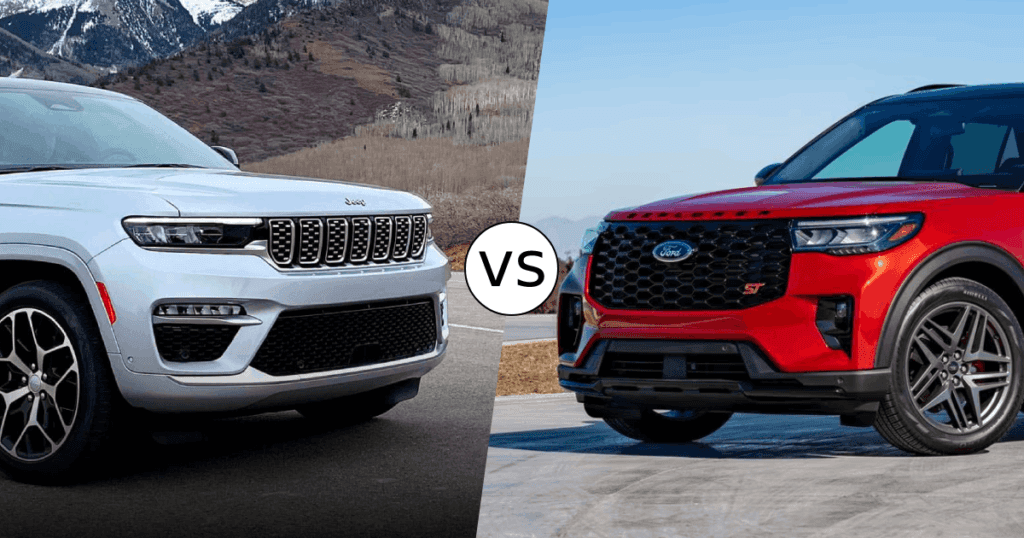
The 2025 Jeep Grand Cherokee and Ford Explorer are no longer rugged SUVs but sophisticated family haulers. Are you trying to decide between these all-American options? Read as we compare the Jeep Grand Cherokee vs. Ford Explorer, breaking down their key differences to help you find the perfect match for driving in Auburn, California, and beyond.
Performance and Engine Options
These SUVs take different paths to deliver power. Jeep keeps it simple with a single V-6 engine option but also offers a plug-in hybrid model. Ford offers two turbo engines with rear-wheel-drive (RWD) or all-wheel-drive (AWD) options.
If you regularly tow a boat or trailer, that can significantly affect your preference. The Grand Cherokee 4xe’s 2.0-liter turbocharged engine outmuscles the Ford completely. Jeep models with the standard V-6 engine can tow up to 6,200 pounds compared to the Ford’s 5,000-pound limit. Ground clearance matters if you like to head off the beaten path. Jeep’s maximum of 10.9 inches beats Ford’s 8.2 inches.
2025 Jeep Grand Cherokee Engine Variants and Specs
The Grand Cherokee’s standard 3.6-liter V-6 engine makes 293 hp and 260 lb-ft of torque and pairs with an eight-speed automatic transmission. The optional 2.0-liter turbocharged plug-in hybrid delivers 375 hp and 470 lb-ft of torque.
2025 Ford Explorer Engine Variants and Specs
Most Explorer trims have a turbocharged 2.3-liter four-cylinder engine that produces 300 hp and 310 lb-ft of torque. The ST model’s turbocharged 3.0-liter V-6 engine generates 400 hp and 415 lb-ft of torque. Both engines pair with a 10-speed automatic transmission. The ST’s V-6 delivers punch for highway passing, but the Explorer’s less impressive ground clearance keeps this SUV on the pavement.
Fuel Efficiency Comparison
Both RWD and AWD versions of the Grand Cherokee achieve an average of 22 mpg combined, with the larger Grand Cherokee L getting slightly less at 21 mpg combined. The thriftiest Explorer with the four-cylinder engine and RWD gets 24 mpg combined. AWD models achieve up to 23 mpg. V-6 models match the Grand Cherokee’s 21 mpg combined fuel economy. Jeep’s 23-gallon gas tank beats Ford’s maximum 20.2-gallon capacity. Fewer stops on road trips, plus superior towing capabilities, make the Grand Cherokee’s slightly lower fuel economy less significant.
Exterior and Interior Design
The aerodynamic design of theJeep Grand Cherokee balances ruggedness and classiness. In contrast, the Explorer’s sleeker, city-focused profile features smoother lines that favor a street-style aesthetic.
Three-row models offer nearly identical interior space. The standard Grand Cherokee seats five people, while the Explorer fits seven. Ford delivers a third row without requiring you to step up to another model, unlike the Grand Cherokee, which requires an upgrade to the Grand Cherokee L for the third row.
Exterior Features and Styling
Each brand stays true to its roots. The adventure-ready Grand Cherokee features higher belt lines and steeper approach angles, while the Explorer hugs the road with smooth curves, making it the ideal highway cruiser.
The more compact Grand Cherokee measures 193.5 inches in length, 77.5 inches in width, and 70.8 inches in height. Its 116.7-inch wheelbase and higher ground clearance ensure it’s easy to park but has enough height for off-road challenges.
The Explorer is 198.8 inches long, 78.9 inches wide, and 69.6 inches tall. Its 119.1-inch wheelbase provides more interior space, especially for third-row passengers. The Explorer’s lower height gives it a car-like look, but you’ll feel every bump on off-road trails.
Interior Comfort, Space, and Technology
The Grand Cherokee runs Uconnect 5 with a standard 8.4-inch touch screen. Apple CarPlay and Android Auto connectivity, voice commands, and a standard six-speaker stereo make commuting in Auburn a pleasure. Higher trims come with 10.1-inch screens with navigation. Top models offer a 19-speaker McIntosh stereo and rear screens with Amazon Fire TV and Wi-Fi connectivity.
Ford redesigned the Explorer’s technology with the Google-based Ford Digital Experience. The standard 13.2-inch screen includes Google Maps, Voice Assistant, wireless Apple CarPlay, SiriusXM with 360L, and Alexa. Most models include a 12-speaker Bang & Olufsen audio system.
The Grand Cherokee excels in luxury touches, offering 16-way massage seats, multicolor ambient lighting, and premium materials. The Explorer fights back with fresh colors and soft surfaces but can’t match the Jeep’s McIntosh audio and rear entertainment for family road trips.
Safety and Reliability
Numerous safety features in these SUVs enhance your confidence when driving through Auburn or visiting the rest of California.
Advanced Safety Features and Ratings
Every Grand Cherokee includes blind-spot warnings. Upper trims add intersection turn assistance and hands-free highway driving. Night vision with animal detection helps during dawn and dusk drives.
Ford counters with comprehensive safety features and an optional 360-degree camera. The Explorer features automatic emergency braking, blind-spot monitoring, a lane-keeping system, and Evasive Steering Assist. Most models offer Ford’s BlueCruise hands-free highway driving system.
Jeep’s hands-free system works on over 200,000 miles of U.S. roads, while Ford’s BlueCruise technology covers 97% of controlled-access highways in North America. The National Highway Traffic Safety Administration gave the 2025 Grand Cherokee a five-star overall safety rating, and the Insurance Institute for Highway Safety named it a Top Safety Pick. U.S. News awarded the Explorer a safety score of 9.7 out of 10.
Reliability and Maintenance Considerations
Both SUVs receive a reliability rating of 3.5 out of 5. RepairPal estimates Grand Cherokee owners spend about $666 yearly on repairs versus $732 for Explorer owners. Owners of Explorers often have problems with the engine, transmission, and electrical system.
The Explorer’s average five-year maintenance cost is $3,123, which is a little less than the Grand Cherokee’s predicted $3,549. The average cost of owning an Explorer for five years is $64,588, whereas the average cost of owning a Grand Cherokee for five years is $70,262. Both come with the same warranties: a standard warranty for three years or 36,000 miles and a powertrain warranty for five years or 60,000 miles.
Pricing, Value, and Final Verdict
The 2025 Grand Cherokee comes in nine trims, ranging from $36,495 for the Laredo A to $63,040 for the Summit Reserve. Ford keeps it simple with four Explorer options: the Active, ST-Line, Platinum, and ST. Pricing starts at $40,050 for the Active trim and goes up to $54,770 for the sporty ST.
U.S. News ranked the Grand Cherokee No. 4 among Midsize SUVs but placed the Explorer at No. 14, favoring the Ford for its impressive standard features, towing capacity, and capable handling, but naming the Grand Cherokee as the better option for ride quality and cutting-edge features.
Find the Ideal SUV at Auburn Chrysler Dodge Jeep Ram
Choosing the right SUV for your lifestyle depends on your priorities. The Grand Cherokee can be the perfect car for you if you desire both luxury and off-road prowess. If you want to check out the 2025 Jeep Grand Cherokee, call our team at Auburn Chrysler Dodge Jeep Ram to set up a test drive. Once you’ve found the perfect setup, our finance team can help you pick the best way to pay for it that fits your goals and budget.